
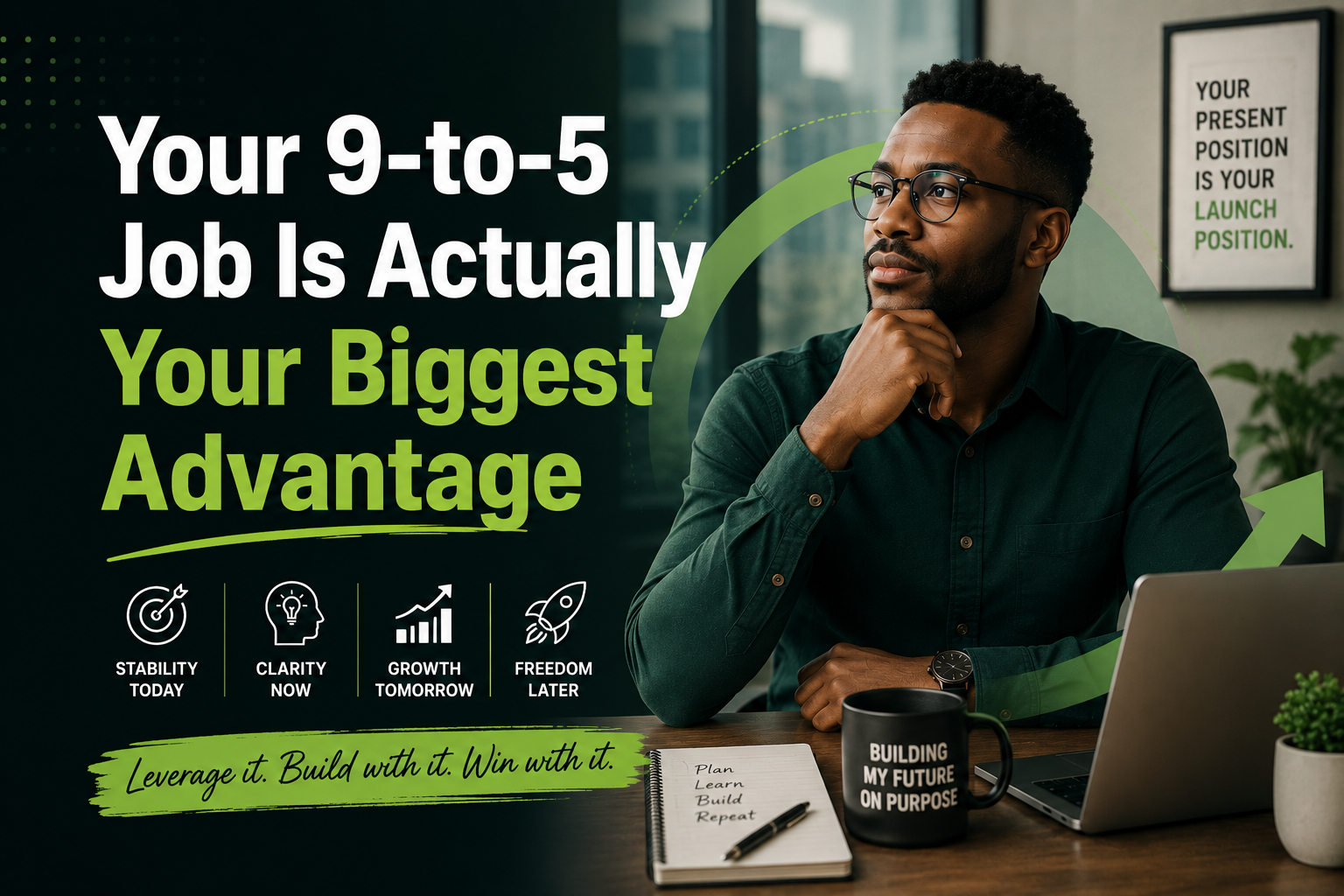
Everyone assumes that a full-time job is the enemy of entrepreneurship. That the path to building something of your own starts the day you walk away from the salary. That until you make that leap, you’re stuck.
That assumption has cost more professionals more time, more money, and more opportunity than almost any other belief in the entrepreneurship space.
Because here’s what nobody tells you: your 9-to-5 isn’t holding you back from building an online platform. In most cases, it’s the very thing that gives you a better shot at succeeding than most full-time founders ever get.
This post is about why — and how to start thinking about your professional life as the unfair advantage it actually is.
The Story We’ve Been Sold About Full-Time Founders
Silicon Valley mythology is built on a specific narrative: young founder drops out of school or quits their job, bets everything, sleeps on a friend’s couch, and emerges years later with a billion-dollar company. The sacrifice is framed as the proof of commitment. The all-or-nothing bet is positioned as the only serious path.
Most people internalise this story and conclude: until I’m ready to go all in, I’m not serious enough to start.
But look more carefully at what that story actually produces:
- A founder making decisions under financial survival pressure — which distorts judgment
- A person who needs the business to work immediately — which creates desperate selling
- Someone who can’t afford to pivot — because pivoting costs time, and time costs money they don’t have
- A builder who skips validation — because they’ve already committed everything and need to believe in the idea
None of those are advantages. They are liabilities disguised as commitment.
“The most dangerous founder isn’t the one who moves too slowly. It’s the one who moves fast in the wrong direction because they can’t afford to slow down.”
What You Actually Have That Most Founders Don’t
When you hold a professional job while building an online platform on the side, you walk into the process with assets that full-time founders spend months — sometimes years — trying to acquire.
Your salary is your seed funding. Every month you keep your job is another month your platform idea gets to breathe, iterate, and find its market without survival pressure distorting your decisions. Most early-stage investors would kill for a founder with this kind of patience built in.
You have spent years inside an industry. You know its inefficiencies, its bottlenecks, the tools that don’t work, the conversations professionals in that space have behind closed doors. That insider knowledge is where the best platform ideas come from — and you have it by default.
Your colleagues, clients, vendors, and industry contacts are potential early customers, referral sources, and validation partners. You don’t need to build an audience from zero. You have direct access to real people in a real market — which is the hardest thing for a first-time founder to get.
Your professional title, your employer’s name, your track record — these are trust signals that make people take your platform seriously before it has a single customer. A 22-year-old dropout pitching an HR platform gets a different reception than a practicing HR Director launching one.
One of the most destructive things an early-stage founder can do is take money from the wrong customer just because they need the revenue. Your salary means you can afford to be selective. You can turn down the customer who will drain your time, distort your product, and pull you away from the market you actually want to serve.
A founder who has quit their job needs their platform idea to work. That need creates a bias that distorts how they interpret feedback, conduct research, and read market signals. You don’t have that problem. You can look at your idea clearly — and kill it if it needs to be killed — without your livelihood depending on the answer.
The One Thing Your Job Can’t Give You
None of the advantages above matter if you use them to avoid the one thing that actually determines whether your platform idea will work.
That thing is validation.
Having financial runway doesn’t help you if you spend it building something the market doesn’t want. Having industry knowledge doesn’t protect you if you mistake familiarity with a problem for proof that people will pay to solve it. Having a warm network doesn’t guarantee customers — it only guarantees conversations, and conversations are not the same as commitments.
Validation is the bridge between your advantages and your outcome. It’s the process of finding out — before you build — whether the market will actually pay for what you’re planning to create.
And it doesn’t require quitting your job. It doesn’t require a finished product. It doesn’t even require a working prototype. It requires a structured set of questions applied honestly to your specific idea, in your specific market, with real people who match your target customer.
What Validation Actually Looks Like for a Working Professional
Most professionals overcomplicate this. Validation isn’t a six-month research project. It isn’t a 40-page business plan. It isn’t even a survey.
At its core, validation answers five questions:
- Who specifically loses money or time because your platform doesn’t exist? Not a general demographic — a specific, nameable type of person with a measurable problem.
- Have you spoken to at least five of those people in the last 30 days? Not surveyed. Not researched. Spoken to — in a real conversation where they could push back.
- Could you deliver a working version of your platform in 30 days without building any technology? The fastest validation is a manual version of your platform — a human-powered process that proves the model before the software exists.
- Can you identify your first 10 customers without spending money on advertising? If you can’t find 10 people through your existing network and channels, the distribution strategy has a structural gap.
- Would at least one person pay for this today — not when it’s better, not when it’s more complete, but right now? Willingness to pay in the future is not validation. Money exchanged today is.
If you can answer all five honestly and positively, you have a validated platform idea. If you can’t — you have a starting point for the conversations that will get you there.
The good news: as a working professional, you have everything you need to run this process in the evenings and weekends of the next 30 days. Without quitting anything. Without spending anything significant. Without betting your livelihood on an untested assumption.
You Have a Platform Idea. Let’s Find Out If It’s Worth Building.
Most professionals skip validation and spend months — and millions — building something the market never asked for. Our structured framework tells you the truth about your idea in days, not months. And you don’t have to quit your job to find out.
See If My Idea Qualifies →No cost to apply. Takes less than 3 minutes.
The Real Question Isn’t Whether You Can Afford to Start
Most professionals frame this as a resource question. Do I have enough time? Do I have enough money? Do I have enough knowledge?
Those are the wrong questions. As a working professional, you have more of all three than most founders who are celebrated for their courage in going all-in.
The real question is whether you are using those resources on the right idea — the one that has a real market, a paying customer base, and a structural advantage you can defend over time.
That’s not a question you can answer with more research. It’s not a question your business plan can answer. It’s a question that only real market validation can answer — and the sooner you run that process, the sooner you know whether to build, pivot, or move on to the next idea entirely.
Your 9-to-5 gave you the stability to ask that question without your survival depending on the answer. That’s not a small thing. Most founders never get that luxury.
Use it.