
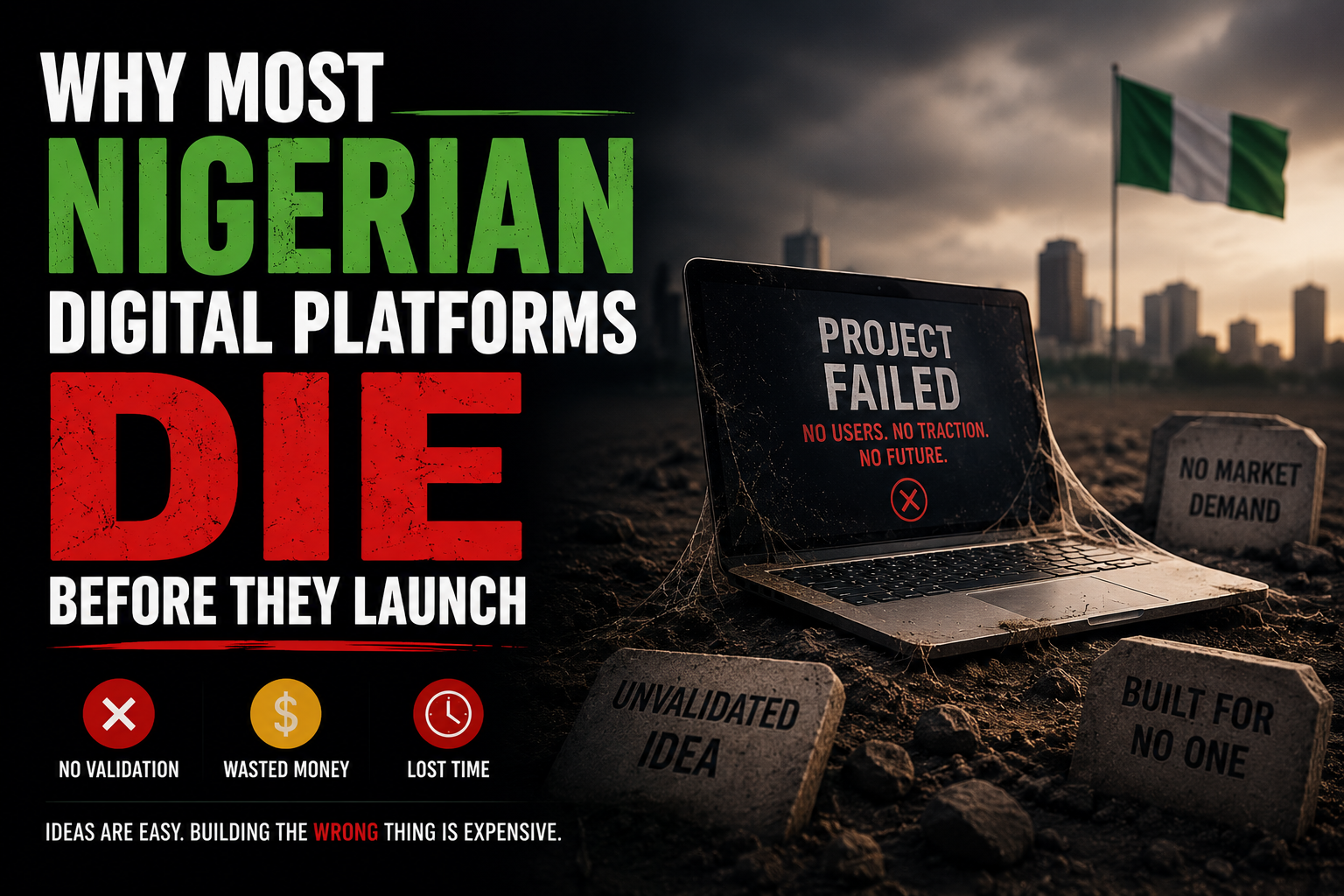
Why Most Nigerian Digital Platforms Die Before They Launch
Somewhere in Lagos right now, a smart, driven professional is sitting in front of a laptop, convinced they have a million-dollar idea. They can see it clearly — the app, the platform, the SaaS product. They’ve told a few friends. Everyone agrees: this is the one.
Twelve months later, the platform is either still “in development” or quietly abandoned. Not because the founder wasn’t talented. Not because the Nigerian market isn’t ready. But because of one decision made right at the beginning — a decision most people don’t even realise they’re making.
They built before they validated.
The real reason is not what most people think
Ask any failed Nigerian founder why their platform didn’t make it, and you’ll usually hear the same answers: “The funding wasn’t there.” “Nigerians don’t like to pay online.” “The infrastructure wasn’t ready.”
These are real challenges. But they are rarely the root cause.
The root cause is almost always this: the platform was built for a problem that wasn’t painful enough, for a customer who wasn’t ready to pay, in a market that wasn’t clearly defined.
The funding problem is actually a confidence problem — investors don’t fund ideas, they fund proven demand. The “Nigerians don’t pay” problem is actually a value problem — people don’t pay for solutions that don’t solve a sharp enough pain. The infrastructure problem is often a timing problem — great founders pick the right problem for the right moment.
All of these trace back to the same starting point: the idea was never tested against reality before money and months were poured into building it.
The “build it and they will come” trap
There is a pattern I have seen repeated across Nigerian tech and professional communities, and I say this having been inside the ecosystem as a developer and business strategist for years.
A professional has a genuine insight — something they experience personally, a gap they notice at work, an inefficiency in an industry they know well. The insight is real. The frustration is real. So they move straight to execution.
They hire a developer. Or they start learning to code. They pick a name, buy a domain, and spend six to eighteen months building. Then they launch.
And almost nothing happens.
Not because the idea was completely wrong. But because somewhere between the insight and the launch, nobody stopped to confirm:
- Who, specifically, is the customer — and are they reachable?
- Is this problem painful enough that they will pay to have it solved?
- How much will they pay, and how often?
- Is there a version of this that can be tested in 30 days without building a full product?
- What would make this idea actually defensible in the Nigerian market?
These are not complicated questions. But they are questions most founders skip — because building feels like progress, and asking questions feels like delay.
“The most expensive thing you can build is a product nobody asked for.”
Not sure if your platform idea will survive the market?
Before you spend another naira on development, let’s pressure-test your idea. Our Platform Validation process helps professionals like you confirm real demand, identify your exact customer, and build with confidence — not assumptions.
Validate My Platform Idea →What skipping validation actually costs
Let’s be concrete about what is at stake.
A basic MVP in Nigeria today — assuming you’re working with even a moderately skilled development team — will cost somewhere between ₦800,000 and ₦3,000,000. That’s before hosting, before marketing, before the pivots that almost always come once the product meets real users.
Beyond the money, there is the time. Most founders spend between six months and two years building their first version. That is two years of evenings, weekends, and mental energy. Two years of opportunity cost.
And then there is something harder to quantify: the emotional weight of watching something you believed in deeply fail to gain traction. For many founders, that experience is enough to make them step back from entrepreneurship entirely.
Validation is not about killing your idea. It is about protecting your investment — your money, your time, and your confidence — by finding out what works before you commit everything to it.
So what does validation actually look like?
Validation is not a survey. It is not asking your friends “would you use this?” (They will say yes. They are your friends.)
Real platform validation is the structured process of confirming — with evidence, not assumptions — that a specific group of real people have a specific problem, that your platform idea is a credible solution to that problem, and that those people are willing and able to pay for it.
It typically involves:
- Idea clarity — sharpening your concept until it is specific enough to test
- Customer discovery — talking to real potential users, not imagined ones
- Market sizing — understanding how many people have this problem and at what price point
- Demand testing — creating a simple proof of concept and measuring real response
- Revenue modelling — confirming the numbers can actually work as a business
Done properly, validation does not take years. It takes weeks. And it tells you, before a single line of code is written, whether you are building something people will actually pay for.
The Nigerian market is not the problem
I want to be clear about something, because I hear this narrative too often and it does enormous damage.
The Nigerian digital market is not unready. Nigerians are not unwilling to pay. The infrastructure, while imperfect, is not the primary barrier.
Nigerian consumers are spending billions of naira digitally every month — on Flutterwave-powered checkouts, on Paystack integrations, on streaming platforms, on digital services of all kinds. The market is there.
What is missing, in most cases, is a platform that is specific enough, trusted enough, and compelling enough to earn that spend. And the only reliable way to build that kind of platform is to start not with a build — but with a question.
Does this idea, for this customer, solve a problem painful enough to pay for?
That question is the beginning of everything.
If you have a digital platform idea and you are not sure whether to build it yet — that instinct is right. The next step is validation, not development. We work with professionals across Nigeria to validate platform ideas quickly and confidently, so that when you do build, you build the right thing.
Start Your Validation Process →